

One of the biggest challenges in delivering compliant passive fire protection (PFP) is coordinating multiple trades on site. Plumbers, electricians, HVAC installers and data cablers all create penetrations through fire-rated elements — often late in the construction program. Without proper coordination, these penetrations can be left unsealed or incorrectly sealed, compromising fire compartmentation.
Why Early Engagement Matters
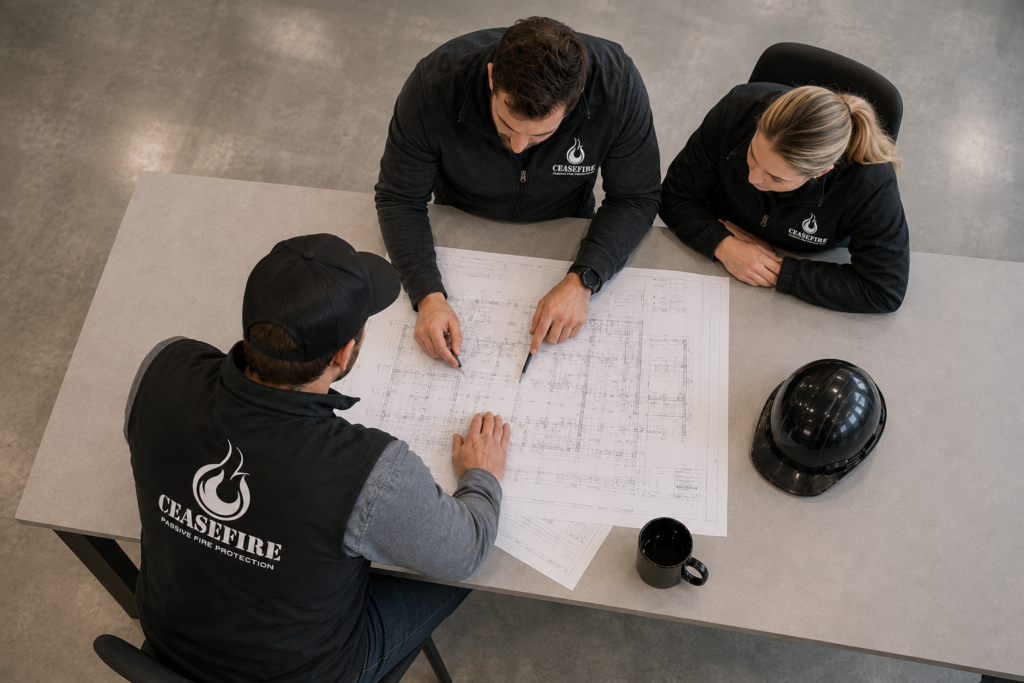
PFP requirements should be communicated clearly to all trades during pre-start. Ceasefire PFP works with site managers at the outset to identify high-risk areas, mark up drawings and establish clear procedures for penetration creation and sealing.
Smart Sequencing
Correct trade sequencing improves both compliance and efficiency:
- Install collars and sleeves before services are pulled to prevent oversized openings
- Group services through shared openings to minimise the number of firestop systems
- Schedule PFP works after major services are installed to avoid rework
Responsibility and Documentation
A common issue is the assumption that “someone else” will handle the firestopping. Responsibility must be clearly defined — either the trade creating the penetration installs a compliant system, or Ceasefire is engaged to do so.
Ceasefire maintains a Passive Fire Register on every project, recording:
- Penetration locations and service types
- Firestop systems installed
- Before-and-after photographic evidence
Typical Coordination Challenges
- Trades cutting through sealed penetrations to add new services
- Incorrect systems installed by non-specialist contractors
- Lack of access after wall or ceiling closure
- Unplanned penetrations requiring new firestop designs
Ceasefire’s Coordination Approach
- Early site walks with all trade supervisors
- Colour-coded tags to identify ownership of penetrations
- Distribution of pre-approved firestop details to every trade
- Rapid-response teams to address unplanned openings
Compliant passive fire protection depends on early communication, smart sequencing and clear accountability across trades. Ceasefire PFP’s proactive coordination ensures penetrations are sealed correctly the first time, avoiding delays, rework and audit failures.