

Fire Compartmentation in Multi-Storey Buildings
Fire compartmentation is a fundamental principle of passive fire protection. By dividing a building into separate fire-resistant zones, it ensures that a fire is contained long enough for occupants to evacuate and emergency services to respond.
How It Works
Compartmentation relies on fire-rated walls, floors and doors that restrict the spread of fire and smoke. The required Fire Resistance Level (FRL) depends on the building’s classification, height and use, as defined by the National Construction Code (NCC).
Vertical vs Horizontal Compartmentation
| Type | Method |
|---|---|
| Horizontal | Fire-rated floor slabs between storeys |
| Vertical | Fire-rated walls, shafts and risers |
Any services passing through these barriers must be sealed with systems tested to AS 1530.4 and installed in accordance with AS 4072.1.
Special Considerations in High-Rise Buildings
- Service risers: require multi-service firestop systems that can be re-entered for future works
- Lift shafts: must be fully separated and pressure-controlled
- Stairwells: need to remain smoke-free as protected egress routes
Ceasefire’s Design Support
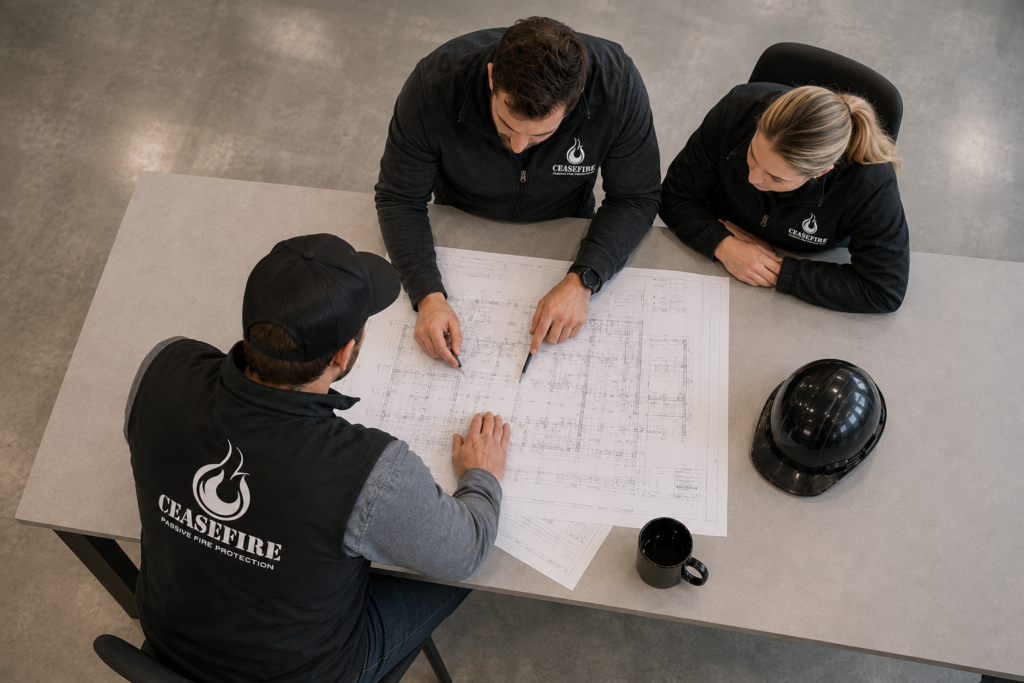
Ceasefire PFP works with architects and engineers during the design phase, providing advice on:
- Grouping services to minimise penetrations
- Selecting tested firestop systems
- Identifying high-risk junctions and interfaces
Common Issues
- Late-stage penetrations with no matching firestop solution
- Reliance on active systems instead of robust compartmentation
- Poor documentation of penetration locations
Maintenance Under AS 1851
Compartmentation is only effective if maintained. AS 1851 requires regular inspection to confirm penetrations remain sealed and no unauthorised openings have been introduced.
Compartmentation is not a design option — it’s a life-safety requirement. By integrating passive fire considerations early, Ceasefire PFP helps ensure every compartment performs when it matters most.