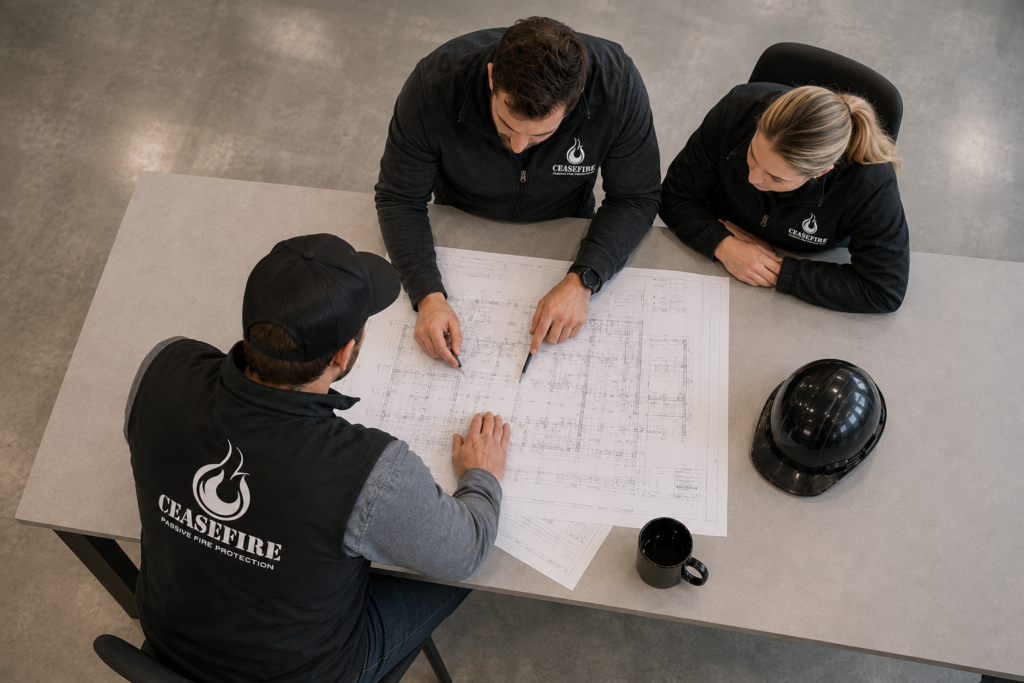


Firestopping is a crucial aspect of passive fire protection, yet our inspections consistently reveal avoidable mistakes that compromise compliance and safety. These errors can lead to failed audits, costly rectifications, and increased liability for builders and subcontractors. Ceasefire PFP has compiled this list of the top 10 mistakes found in firestop installations to help raise industry standards.
- Using Non-Tested Products
The most common error is using sealants, foams, or collars with no AS 1530.4 test evidence for the exact service and substrate combination. Without testing, the FRL claim is invalid. - Mixing Components from Different Systems
Firestop systems are tested as complete assemblies. Mixing a collar from one manufacturer with mastic from another voids certification unless a composite test exists. - Wrong Side Installation
Certain systems, especially fire collars, are tested for installation on a specific side of the wall or floor. Installing them on the wrong side reduces performance. - Incorrect Annular Gap Size
Every system has a tested maximum gap tolerance. Exceeding this without approved backfilling materials means the system will not perform as intended. - Inadequate Depth of Sealant
Applying sealant too thinly or without backer rod reduces its fire resistance capacity. - Missing Mechanical Fixings
Systems requiring screws, anchors, or steel straps often fail in a fire if these components are omitted. - Incompatible Substrate
Installing a system tested for concrete into plasterboard, or vice versa, without a tested report leads to non-compliance. - Poor Surface Preparation
Dirty, oily, or damp surfaces reduce adhesion of sealants and bonding of boards, leading to early failure. - No Identification Labels
Firestop systems should have visible product labels. Missing tags make compliance verification difficult during inspections. - Lack of Documentation
Even if a system is installed correctly, without photos, test reports, and an entry in the Passive Fire Register, it may not pass certification.
Ceasefire PFP’s Quality Assurance Approach
To eliminate these common errors, Ceasefire PFP ensures that every installation follows a strict QA process:
- Selection of systems verified against the relevant test report
- Substrate prepared in accordance with manufacturer instructions
- Correct anchor spacing and sealant depth maintained
- Every penetration photographed and tagged
- Immediate updates to the Passive Fire Register
By addressing these issues proactively, builders can reduce rework, save time, and — most importantly — ensure that the building’s fire protection performs when it matters most.
Ceasefire PFP delivers compliant, fully documented installations so our clients never fail an inspection for poor firestop practices.